AMD has made an inevitable yet slightly aggressive move. At Mobile World Congress, the company announced the Ryzen AI Pro 400 Series, a lineup of silicon that, for the first time, features a dedicated Neural Processing Unit (NPU) shoved into a desktop processor.
You may have heard a lot about AI PCs since last year and assumed that was just a marketing buzzword meant to sell sleek laptops to digital nomads. But the trend is officially coming for the beige (or, more likely, matte black) box placed under your office desk.
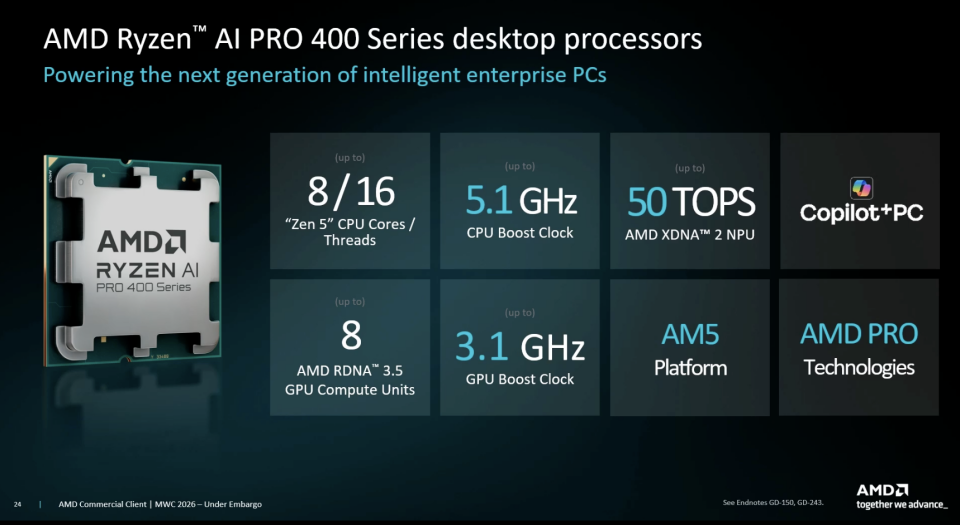
AMD debuted its XDNA 2 NPU architecture at CES in January, but it was initially a laptop-exclusive. The Ryzen AI 400 mobile lineup received all the attention. Desktops were promised “later.” Well, later is now. The new desktop chips arrive in Zen 5 configurations with up to 8 cores and 16 threads, RDNA 3.5 graphics with up to 8 compute units, and an XDNA 2 NPU rated at 50 TOPS that clears Microsoft’s 40 TOPS bar for Copilot+ certification with room to spare.
For years, the standard business desktop was a “set it and forget it” affair—enough RAM to handle 40 Chrome tabs and a processor that wouldn’t catch fire during a Zoom call. But Microsoft’s push for Copilot+ has changed the hardware requirements for the modern cubicle.
By integrating the XDNA 2 architecture into desktop chips, AMD can solve a specific logistical problem for IT departments. Previously, Copilot+ features like real-time translation, background blur, and local generative AI tasks were mostly limited to high-end laptops and powerful hardware. With the Ryzen AI Pro 400 series, AMD wants to say that the desktop shouldn’t be the foolish relative in the enterprise family.
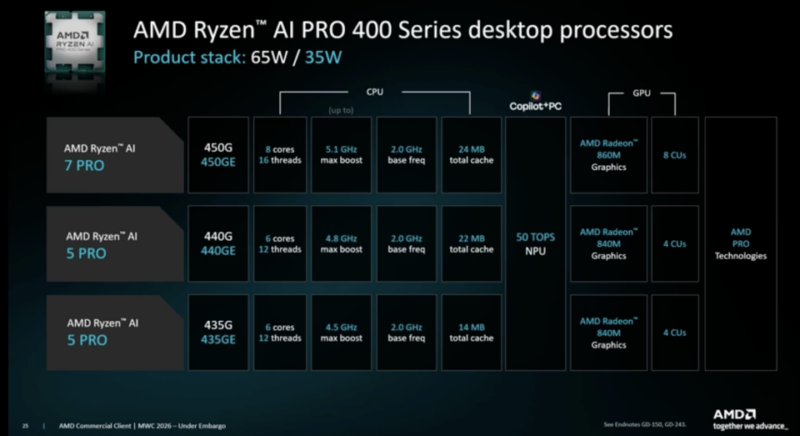
The lineup is headlined by Ryzen AI 7 Pro that ships with 8 CPU cores with up to 5.1GHz clock speeds and RDNA 3.5 graphics. The other SKUs are Ryzen AI 5 Pro 440G with 6 cores and a 4.8GHz clock speed, and the Ryzen AI 5 Pro 435G, also at 6 cores with a 4.5GHz boost — each available in 65W “G” and 35W “GE” power editions. The lower-wattage GE chips are aimed at slim mini-PCs and compact form-factor builds that businesses love to bolt behind monitors.
The real kicker for the corporate world, however, is the efficiency, as Team Red offers 35-watt variants of these chips. For the uninitiated, that means PC manufacturers like HP, Dell, and Lenovo can cram these high-end AI processors into “Tiny” or “Micro” form factors in small 1-liter PCs. It’s a niche but crucial market for hospitals, banks, and cramped call centers that want AI powers without the footprint of a mid-tower.
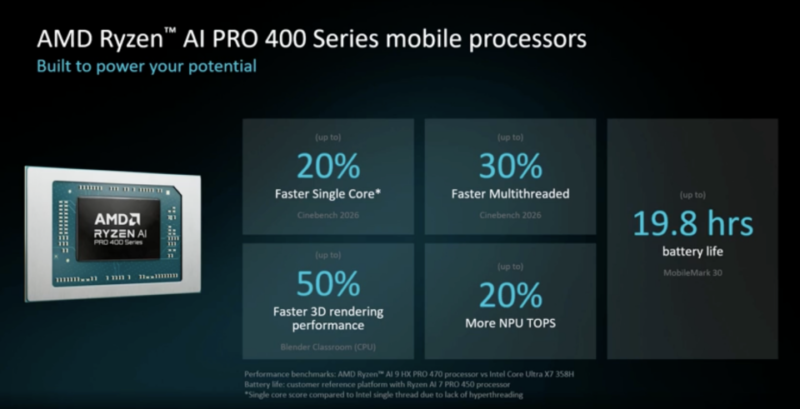
While the desktop NPU is the star of the show, AMD has also refreshed its mobile stack. The Ryzen AI 9 HX Pro 470 is being introduced as the “Intel Killer.”
AMD is throwing down the gauntlet, going head-to-head with Intel’s Panther Lake with a claim of almost 20 hours of battery via MobileMark 30, along with 20% fast single-core and 30% quick multithreaded performance in Cinebench 2026 versus the previous gen. In the enterprise world, battery life is the only spec that competes with security for the top spot on a procurement officer’s wishlist. If Team Red can deliver 19.8 hours of juice on local AI workloads, Intel’s dominance in the corporate fleet is in real trouble.
Is the Software Ready?
Here’s the wry truth: AMD is currently building a very expensive highway before most people have cars to drive on it. Although the hardware is impressive, the “200+ commercial designs” promised by Q2 will only be as good as the software that uses that NPU. Currently, the NPU is largely a future-proof tax. You buy it so that when your company forces a proprietary AI tool onto your system in 2026, the computer won’t grind to a halt.
AMD has done its part by being the first to bring this specific architecture to the desktop. They’ve given businesses a reason to upgrade hardware that many companies were happy to leave alone for another five years.
As for when any of this appears in actual products, AMD will only sell these desktop APUs through OEM systems, partly because Copilot+ certification requires at least 16GB of RAM, which AMD can’t guarantee with a chip shipped in a retail box.