
China’s AI hardware push is no longer a domestic substitution effort, but it now looks like an export strategy in the making. New forecasts suggest that by 2028, the country’s homegrown AI chip manufacturers won’t only meet local demand but will surpass it by a wide margin, and that surplus, naturally, will need a destination. If you ask NVIDIA CEO Jensen Huang, that destination will be everywhere.
China’s AI Chip Output Moves Beyond Domestic Demand
Over the past few years, Beijing’s strategy toward self-reliance in AI computing has kicked China’s semiconductor ambitions into a high gear. Companies like Huawei, Cambricon, Biren, and an ever-increasing constellation of second-tier players are working day and night to roll out AI accelerators at a pace that would’ve sounded like science fiction a decade ago.
According to Bernstein’s latest analysis (via Jukan), domestic production has scaled so aggressively that China is on track to outproduce its own AI chip demands within four years.
Bernstein just put out a report saying China will be producing more domestically made AI chips than its own domestic demand by 202. pic.twitter.com/dF0qqPO8Cn
— Jukan (@jukan05) December 4, 2025
At the center of this surge sits Huawei—now projected to capture roughly 50% of China’s AI chip market by 2026, a figure that would have been laughable back when U.S. export rules first kneecapped the firm’s access to advanced foundry nodes. Huawei’s AI silicon is on the verge of improvement, the company’s ecosystem thickens, and its roadmap will likely be an unapologetic sprint.
With all the above talk, the manufacturing is the concern. Huawei has trouble controlling its own high-end production capacity, and China’s leading foundry, SMIC, isn’t TSMC-level yet. But that gap has been narrowed down, and Huawei is reportedly set to stand up its own fabs with local government backing, an old-school industrial policy play that Beijing has always excelled at.
There’s also the matter of HBM (high-bandwidth memory), now the lifeblood of any competitive AI accelerator. Supply has been a huge constraint, but Bernstein expects China to resolve that too. Quietly, steadily, piece by piece, the puzzle is most likely to be solved in the end.
NVIDIA CEO Flags Risks of a Global Push for Chinese AI Technology
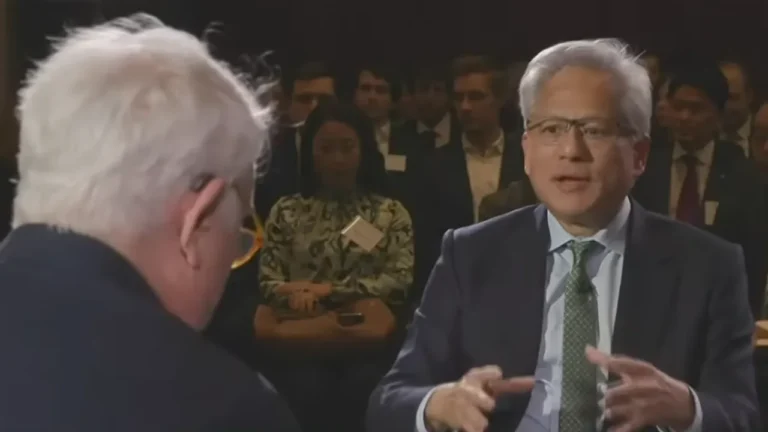
During an interview with the Center for Strategic and International Studies in Washington, NVIDIA CEO Jensen Huang made remarks that China is likely to expand its AI hardware and software ecosystem on the global market. He said that China’s current production levels give an intent to export AI systems, not just supply its domestic market.
Huang referred to this strategy as an “AI Belt and Road,” and suggested that Chinese companies (particularly Huawei) aim to build their tech as a foundation for emerging AI markets, and the U.S. shouldn’t concede the Chinese market and should compete for it.
Huang’s comments hide concerns about U.S. export controls that have accelerated the development of Chinese alternatives to NVIDIA’s products. Huawei’s recent AI systems are evidence of China’s reduction of its reliance on American technology. Despite these changes in the AI chip industry, the U.S. still leads in many areas like advanced semiconductor production, system design, and AI development tools. However, analysts warn that these advantages can be gone for good if China expands its domestic production capacity and begins exporting AI systems at scale.