OpenAI didn’t wait long to answer Google’s Gemini 3 challenge. After a week of hints, GPT-5.2 arrived—pushed out faster than planned, reportedly because Gemini 3 and Anthropic’s Opus 4.5 were getting momentum. The question now is simple: does GPT-5.2 overtake Gemini 3, or just narrow the gap? Let’s take a clear look.
GPT-5.2 Takes Aim at Professional Work
OpenAI declares GPT-5.2 as a workhorse model built for structured, detailed tasks—spreadsheets, presentations, long-context analysis, and multi-step projects. The company said, “We designed GPT‑5.2 to unlock even more economic value for people; it’s better at creating spreadsheets, building presentations, writing code, perceiving images, understanding long contexts, using tools, and handling complex, multi-step projects”.
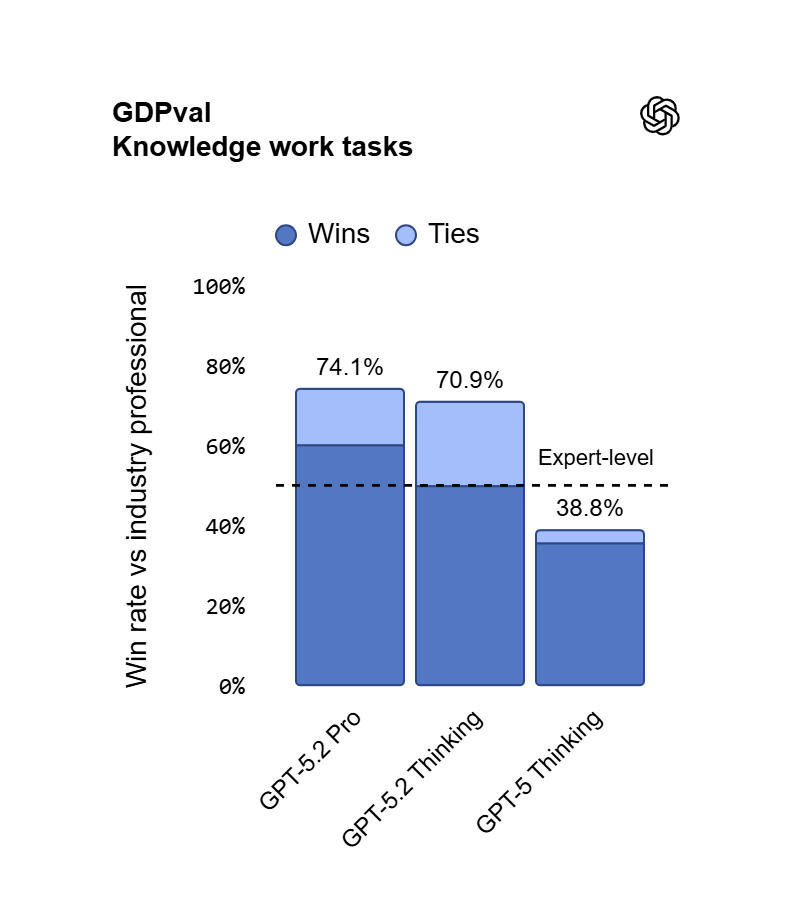
In the company’s GDPval benchmark, which measures how closely a model’s output matches the work of real professionals, GPT-5.2 Thinking rose to 70.9%, almost doubling GPT-5.1’s score of just 38.8%.
The model is not only more accurate, but it’s even faster and very cheap to run, which is a plus point for teams who automate high-volume tasks. OpenAI claims GPT-5.2 can produce outputs at over 11x the speed and under 1% of the cost of a human professional in their tests. “GPT‑5.2 Thinking produced outputs for GDPval tasks at >11x the speed and <1% the cost of expert professionals, suggesting that when paired with human oversight, GPT‑5.2 can help with professional work. Speed and cost estimates are based on historical metrics; speed in ChatGPT may vary,” the company wrote.
That may sound marketing term, but the baseline improvements are visible across coding, long-context tasks, and document-heavy workflows. OpenAI also cut hallucinations by 30% and strengthened safety responses. These are incremental improvements, but they matter for enterprises that use these models in production.
GPT-5.2 Improves in Coding, Long Context, and Vision
The biggest practical jumps have been shown in three areas:
- Coding: GPT-5.2 hits an amazing 55.6% on SWE-Bench Pro, and OpenAI says its debugging and feature-implementation abilities require less manual cleanup.
- Long context: Accuracy stays more stable across long reports and large document bundles.
- Vision: The model handles diagrams, dashboards, and UI layouts more reliably, thanks to better spatial understanding.
These are the areas where users mostly felt Gemini 2.5 and Gemini 3 had a lead. GPT-5.2 doesn’t eliminate that gap everywhere, but it definitely has reduced it.
But Gemini 3 Still Has the Big Lead
Gemini 3 takes the lead on LMArena. It stands out in almost everything—text, vision, multimodal stuff, search, and even generative media. Google’s model is sitting at the top in most areas, while GPT-5.2 hasn’t made it onto every leaderboard yet. Gemini 3 currently dominates overall AI performance rankings, though GPT-5.2 is mainly good in web development and coding tasks for the time being.
And Google offers more places to use Gemini, like in AI Mode, Google Workspace integrations, NotebookLM, and Google AI Studio. OpenAI’s ecosystem is strong, but Google controls the operating systems and the apps people use every day, and that’s why its models get more exposure.
Head-to-Head Benchmarks: A Mixed Scorecard
The benchmark data released by both companies shows a split picture rather than a decisive win for either side. GPT-5.2 leads in the areas where OpenAI has put its efforts, including math-heavy tasks, coding powers, and accuracy-driven evaluations. Gemini 3, meanwhile, performs better on broad reasoning tests and general knowledge benchmarks, which shows Google’s emphasis on large, versatile multimodal systems.
Where GPT-5.2 beats Gemini 3:
- SWE-Bench verified: 80% vs 76.2%
- GPQA Diamond: 92.4% vs 91.9%
- AIME 2025 (without tools): 100% vs 95%
Where Gemini 3 beats GPT-5.2:
- MMMLU: 91.8% vs 89.6%
- HLE (without tools): 37.5% vs 34.5%
In short, the performance of both models on the benchmark is top and bottom – one beats in one area, the other tops in different. You can find the complete benchmark performance at OpenAI and Google.
Features and Access: Gemini Has the Platform Advantage
GPT-5.2 is fully available across OpenAI’s ecosystem through ChatGPT Plus, Pro, Business, Enterprise, and the API, which makes it straightforward to use in OpenAI’s workflow. But Google’s reach is large. You find Gemini 3 in almost all everyday services, including Google AI Mode, Google Workspace, NotebookLM, and the Gemini apps on web and mobile. Developers can access all Google AI models on Google AI Studio and build advanced development projects.
Google also keeps an advantage in multimodal tools: Gemini 3 can generate images, videos, and mixed-media outputs within the same environment, while OpenAI splits video creation into the separate Sora product. In day-to-day use, that means Gemini 3 offers more facilities under one roof, even if GPT-5.2 outperforms it in some specialized tasks.
GPT-5.2 vs. Gemini 3 Pricing: Essentially a Draw
On cost, neither company has much advantage. User access sits at the same $20 per month tier for both ChatGPT Plus and Google AI Pro, and the more advanced plans are similarly aligned. API pricing is also nearly similar, with minor differences that cancel out based on whether you consume more input tokens or generate more output.
This is the current API pricing for both:
- GPT-5.2: $1.75 / $14 per million tokens
- Gemini 3: $2 / $12 per million tokens
In practice, the prices are so close that they won’t sway anyone’s choice. What matters is which model fits a user’s workflow better. Do you want Gemini’s broad product integration or GPT-5.2’s edge with professional, structured tasks? It’s up to you.
Does GPT-5.2 Surpass Gemini 3?
GPT-5.2 doesn’t outperform Gemini 3 in a full range of capabilities but manages to beat it in a few work-focused areas that OpenAI is targeting. The new model is noticeably improved in coding, structured professional tasks, mathematical benchmarks, and long-context handling. Whereas Gemini 3 is still ahead in broad reasoning, multimodal performance, generative media features, and overall benchmark dominance. Also, being integrated across Google’s wider product ecosystem, the model gets more real-world reach.
In other words, GPT-5.2 is the better choice for users who heavily depend on AI for detailed work such as coding, analysis, and document-heavy tasks, while Gemini 3 is still the most powerful general-purpose system. Neither model overtakes the other; instead, they dominate in different market segments.